AIOps
Automation
Data Engineering
Observability
Why Raw Data is the Enemy of Automation


Nick Randall
April 21 • 6 Min Read
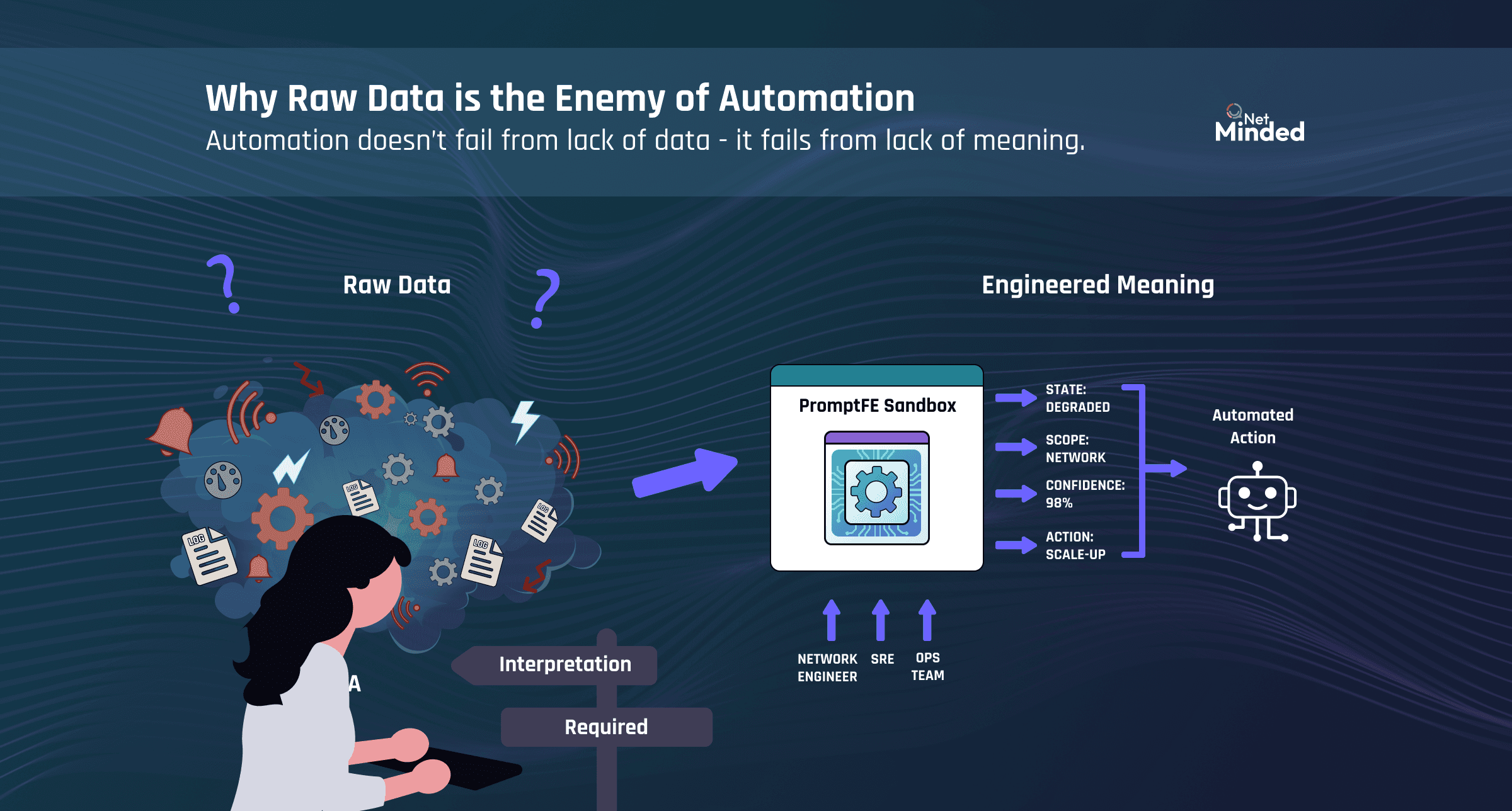
Automation doesn’t fail from lack of data - it fails from lack of meaning.
Most organisations think they need more data.
They don’t.
They need less raw data.
Because raw telemetry doesn’t enable automation.
It quietly prevents it.
The Mistake Everyone Makes
The industry still follows this pattern:
Collect → Store → Analyse → Automate
It feels logical.
It is wrong.
Because by the time you reach “automate,” you are still dealing with:
Fragmented signals
Undefined meaning
Human interpretation
If a human still has to interpret the data…
You don’t have automation.
Raw Data Is Not Neutral
A metric like:
Latency = 28ms
Is not an insight.
It’s a question.
And every question introduces delay, inconsistency, and risk.
At scale, thousands of these “questions” become:
Alert storms
War rooms
Conflicting opinions
Raw data doesn’t clarify.
It multiplies uncertainty.
Why Automation (and AI) Stall
Automation requires trust in the input.
Raw telemetry doesn’t provide that.
So what happens?
Thresholds are debated endlessly
Automation is held back
Humans stay in the loop
With AI, the situation gets worse:
Noise increases
Context is missing
Outputs become inconsistent
AI doesn’t solve raw data.
It exposes the weakness of it.
The Real Problem: Who Owns Interpretation?
Here’s the part most organisations miss:
Automation fails because interpretation is informal, inconsistent, and human-bound
Interpretation today lives:
In engineers’ heads
In ad-hoc scripts
In disconnected dashboards
It is:
Hard to reuse
Impossible to scale
Invisible to automation
Difficult to audit
So every incident starts from scratch.
What Automation Actually Needs
Automation doesn’t need more data.
It needs pre-built meaning.
For a system to act, it must receive:
A clear state
A defined scope
A likely cause
A level of confidence
Not:
Raw metrics
Logs
Time series
Those are inputs.
Not decisions.
The Shift: Engineering Meaning Upstream
This is the shift:
From:
Data → Interpretation → Action
To:
Engineered Input → Action
But this creates a new challenge:
👉 Who defines that engineered input?
Because this is not a developer problem.
It is a domain expertise problem.
Where PromptFE Changes the Game
PromptFE solves this by giving Subject Matter Experts control of interpretation.
Not through code.
But through a no-code, structured sandbox environment.
Using PromptFE:
Network engineers
SREs
Operations teams
Can define:
What “good” looks like
What “degraded” means
How signals relate across systems
What constitutes a real issue
All without writing code.
One Interface. All Telemetry. Consistent Logic.
This is the critical unlock.
PromptFE provides:
👉 A single, consistent interface to engineer meaning across:
Network telemetry
Application metrics
Infrastructure signals
Any data source
Instead of:
One-off scripts
Tool-specific logic
Hidden thresholds
You get:
Standardised feature definitions
Reusable logic
Cross-platform consistency
And critically:
Full audibility of how every decision is derived
As established earlier, this creates a consistent interpretation layer that both humans and AI can trust and consume directly .
From Tribal Knowledge to System Capability
What was previously:
Tacit knowledge
Experience-based judgement
Locked inside individuals
Becomes:
Explicit
Structured
Reusable
Scalable
This is the real transformation.
You are not just improving data.
You are capturing expertise as infrastructure.
What Changes When SMEs Are Enabled
When subject matter experts can define interpretation directly:
Automation becomes trustworthy
AI receives clean, structured inputs
Teams align on a single version of truth
Time-to-action collapses
Most importantly:
Interpretation happens once — and applies everywhere
The Uncomfortable Truth
Raw data feels powerful.
But it forces:
Repeated thinking
Repeated debate
Repeated delay
At scale, that is operational drag.
The Bottom Line
If your automation still depends on humans interpreting telemetry…
You don’t have an automation problem.
You have an interpretation problem.
PromptFE solves it by:
Removing raw data from the decision layer
Giving SMEs a no-code way to define meaning
Applying that meaning consistently across all systems
One Line to Take Away
You can’t automate what still needs to be interpreted — so make interpretation a system, not a person.

Resources
Copyright NetMinded, a trading name of SeeThru Networks ©