PromptFE
FTTH Operations
Network Observability
AIOps
Telemetry Everywhere, Truth Nowhere: The FTTH Operations Gap


Nick Randall
March 31 • 5 Min Read
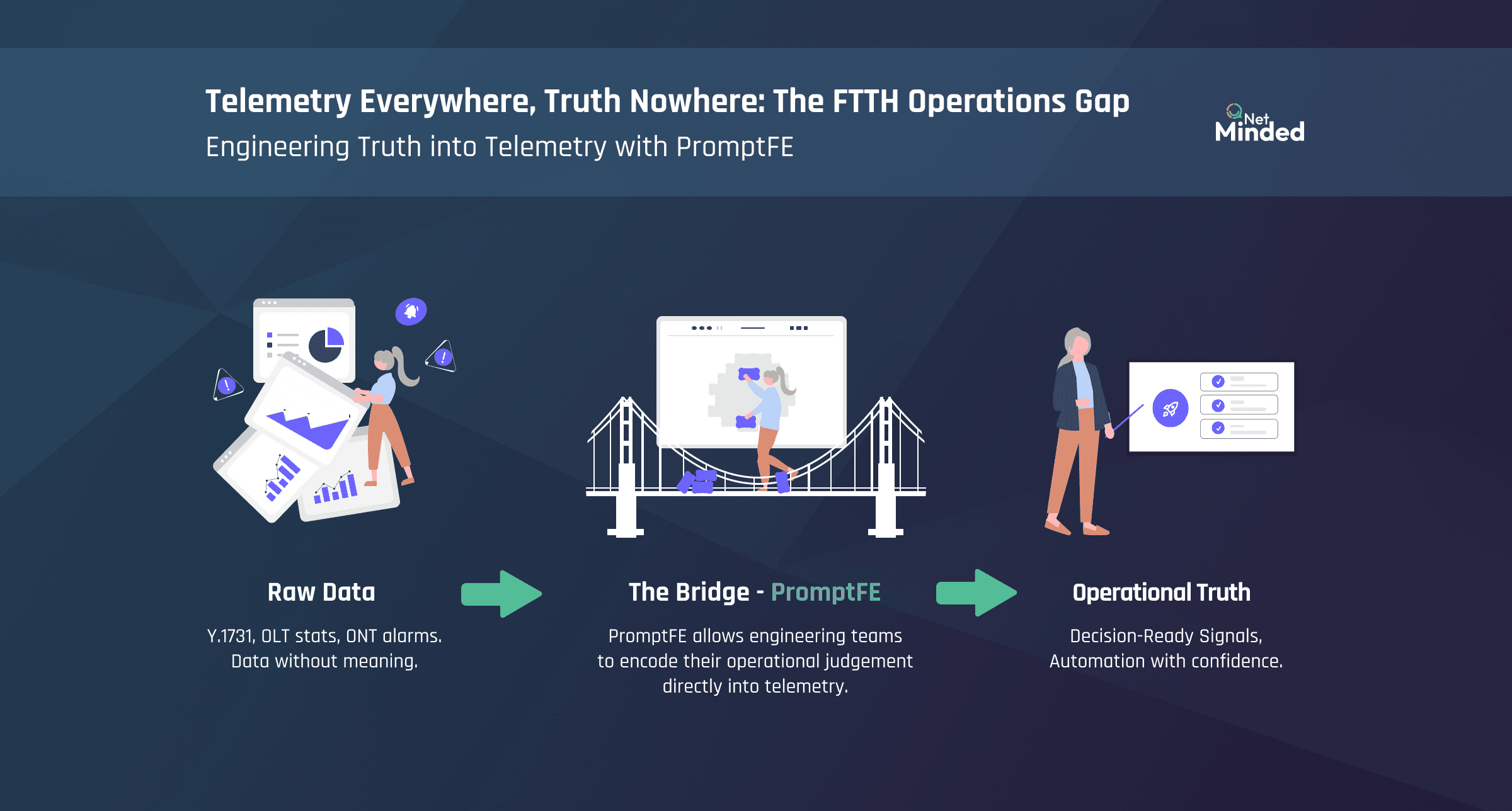
Engineering Truth into Telemetry with PromptFE
The Illusion of Visibility
FTTH networks are among the most instrumented environments in telecom.
Operators collect:
Y.1731 measurements across thousands (or millions) of ONTs
OLT counters and alarms
Optical telemetry from the access layer
Streaming data into platforms like InfluxDB and Prometheus
On paper, this should mean complete visibility.
But ask any operations team a simple question:
“What is the state of this service right now?”
And the answer is rarely immediate — or consistent.
Data Is Not Truth
Y.1731, ONT telemetry, and OLT stats are measurement systems.
They describe:
latency
loss
continuity
signal levels
But they don’t tell you what those measurements mean.
A spike in latency might be:
a transient artefact
a congestion signal
a developing fault
or completely irrelevant
The data doesn’t decide.
The engineer does.
The Hidden Layer: Interpretation
Every operational decision depends on an invisible step:
interpretation
Engineers continuously translate raw telemetry into judgement:
“this looks normal”
“this is degrading”
“this needs escalation”
That translation is:
undocumented
inconsistent
dependent on experience
And critically:
it does not exist in the data itself.
Fragmented Reality
The problem compounds because the data is spread across systems:
Y.1731 tools show path performance
OLT systems show port and PON state
NMS platforms show alarms
Customer systems show symptoms
Each system provides a partial truth.
None provide the full picture.
So operators are forced to:
pivot between tools
mentally correlate signals
build a narrative in real time
This is not observability.
It’s reconstruction.
Why Dashboards Don’t Solve It
Modern dashboards look impressive.
They provide:
real-time graphs
historical trends
alert overlays
But they still leave a critical gap:
They show what happened, not what it means.
A graph might clearly show degradation.
But it doesn’t answer:
Is this actionable?
Who owns the problem?
What happens next?
So the operator is still required to interpret.
The Threshold Trap
To reduce ambiguity, operators introduce thresholds:
latency > X → alert
loss > Y → alarm
But FTTH networks don’t behave uniformly.
Different services have different tolerances
Different PONs behave differently
Time-of-day effects distort baselines
So thresholds either:
fire too often (noise), or
miss real issues (blind spots)
This leads to the worst of both worlds:
alert fatigue
lack of trust
The Scaling Problem
As networks grow, telemetry scales.
But interpretation doesn’t.
This creates a structural bottleneck:
Tier 1 teams escalate too much
Tier 2/3 teams become overloaded
automation initiatives stall
mean time to resolution remains high
In effect:
the network scales, but operational truth does not.
Why This Matters Now
The industry is pushing toward:
AIOps
closed-loop automation
AI-assisted operations
But these systems depend on one thing:
reliable, decision-ready inputs
Raw telemetry doesn’t meet that requirement.
Without a layer that converts data into meaning:
AI produces noise
automation becomes risky
trust breaks down
The Real Gap
FTTH doesn’t have a telemetry problem.
It has a truth gap.
Between:
what the network reports
and what the operator understands
There is a missing layer:
where data becomes meaning
where signals become decisions
where ambiguity is removed
Today, that layer is human.
And that doesn’t scale.
Engineering Truth into Telemetry
The gap between telemetry and truth isn’t a tooling problem.
It’s a translation problem.
Until now, that translation has lived in the heads of experienced engineers — applied manually, inconsistently, and at a scale that doesn’t match modern FTTH networks.
What’s needed is a way to make that judgement:
explicit
repeatable
and usable by machines
This is where Prompt Feature Engineering (PromptFE) comes in.
PromptFE allows engineering teams to:
encode their operational judgement directly into telemetry
transform raw measurements into structured, decision-ready signals
attach context and explanation to every outcome
So instead of asking:
“What does this data mean?”
Your systems already know.
And your automation can act with confidence.
Links
Finchetto: https://finchetto.com/
T1Nexus: https://t1nexus.com/

Resources
Copyright NetMinded, a trading name of SeeThru Networks ©