Survivability Modelling
Network Reliability
Predictive Maintenance
Telecom Analytics
Survivability Models for Networks


Alan Holt
November 28 • 5 Min Read
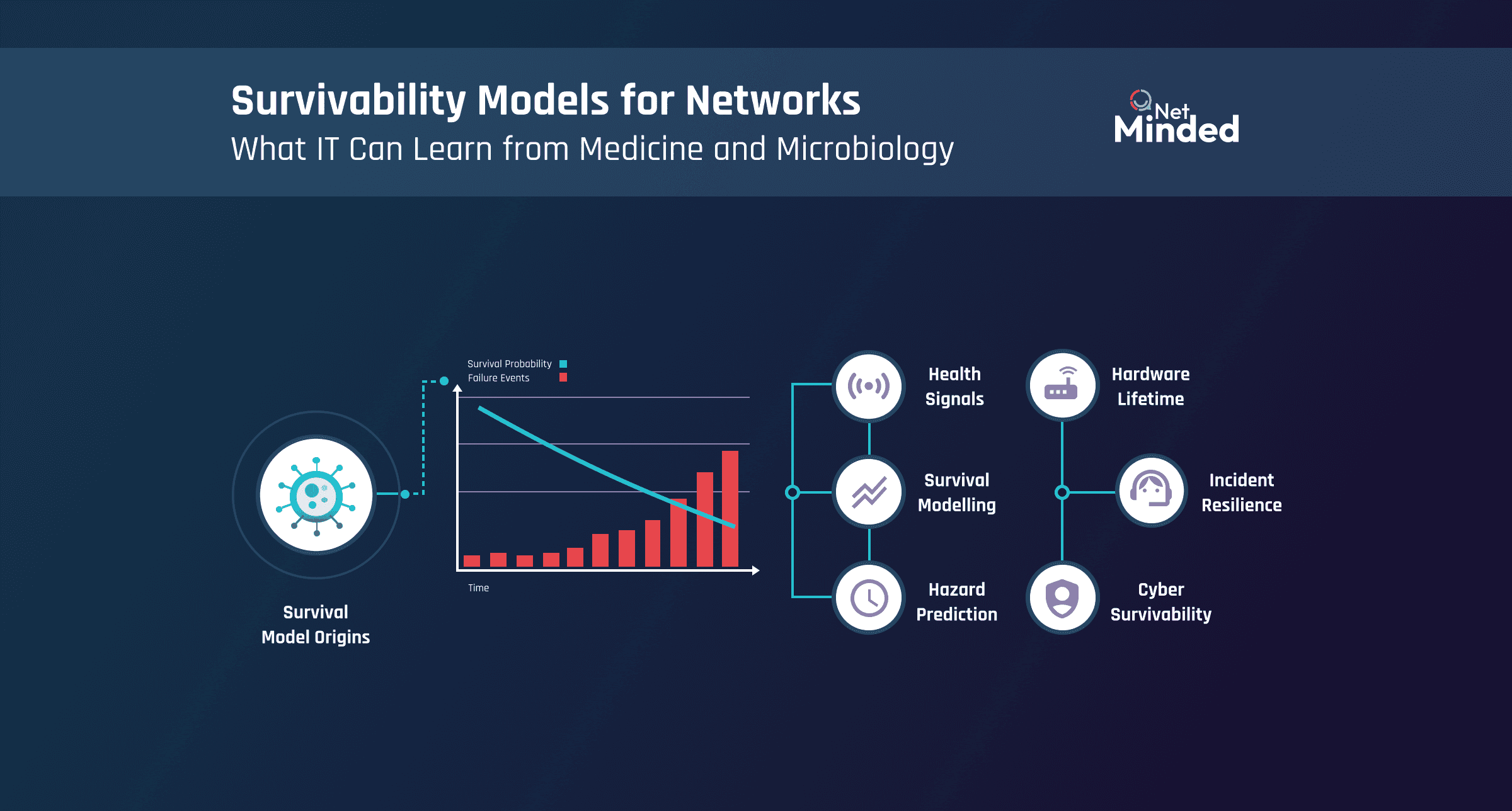
What IT Can Learn from Medicine and Microbiology
Most people think of survival analysis as something belonging to medicine, epidemiology, or actuarial tables, the maths that tells us how long a patient is likely to live, or how a treatment affects their chances day-by-day. But the techniques that transformed clinical research are just as powerful in digital infrastructure.
In MNOC, we’ve been exploring survivability scoring as a next step beyond point-wise scoring — a way of estimating not only how healthy something looks right now, but how long it’s likely to stay that way. In other words, MTBF reimagined through the lens of modern machine learning.
And it turns out the medical lineage of survival analysis fits telecommunications surprisingly well.
A Quick Look Back: Why Survival Analysis Exists at All
The roots go back to the 17th century, when the first mortality tables were constructed to understand lifespan patterns. Over centuries, the field evolved into a sophisticated mathematical discipline. Landmark innovations such as:
The Kaplan–Meier estimator for modelling survival curves, including incomplete (censored) data
The Cox proportional hazards model for identifying factors that increase or decrease risk
Hazard functions that show instantaneous likelihood of failure
…became the backbone of modern medical research.
But the key innovation wasn’t statistical elegance — it was the ability to reason about systems where you don’t observe every failure, where the experiment ends before the subject does, and where the clocks keep ticking even when the data doesn’t.
This is exactly what we face in complex networks.
Why Survival Analysis Maps so Naturally to Telecoms and IT
Networks behave just like biological systems: they degrade, adapt, recover, and occasionally fail in unpredictable ways.
They produce timestamped observations with censoring everywhere:
A transceiver that hasn’t failed yet
An incident that’s still ongoing
A user who is still active
A container that hasn’t hit resource limits
Traditional regression can’t incorporate these “not yet” states: survival models were built for this kind of messy reality.
This is why survivability scoring is such an attractive complement to MNOC’s existing scoring approach: where point-wise scoring shows current health, survival models show future resilience.
Use Case 1: Hardware Lifespan and Predictive Maintenance
Transceivers, SSDs, optics, radio units, power supplies, all components experience time-dependent wear.
Survival analysis lets you:
Model expected remaining life under different temperatures or loads
Estimate hazard curves (e.g., bathtub curves for optics)
Predict failure probability over the next day/week/month
Trigger proactive replacements before a fault becomes visible
Combine this with MNOC scoring and you get a powerful capability: shared survivability awareness across operator + vendor ecosystems.
Use Case 2: Service Lifecycle and User Behaviour
SaaS teams already use survival analysis for churn modelling. now, IT teams can do the same:
Time until user churn
Time between logins
Time until a customer adopts a feature
Time until an SME’s ticket rate spikes
In MNOC terms, this becomes service survivability: not “will a user churn?” but “when does customer experience start to drift from healthy to unhealthy?”
Use Case 3: Incident Management and Operational Maturity
Incidents have a lifecycle. Survival models help teams understand:
Time to incident resolution
Probability of recurrence within X hours
Time until next outage for a given domain
Hazard rate of breaches against SLAs
In an MNOC context, these become operational survivability scores — a way of communicating risk in a clear, vendor-neutral form.
Use Case 4: DevOps and CI/CD Reliability
Builds and deployments behave like biological experiments:
Time until a build fails
Probability a service survives integration tests
Time between successful deployments
Time to first outage after new code hits production
Survival analysis gives DevOps teams a way to reason about reliability across thousands of noisy test runs. Add MNOC scoring on top and you have a shared language for building health that works across teams, tooling, and vendors.
Use Case 5: Cybersecurity Risk and Exploitation Windows
Every unpatched vulnerability has a “survival clock”:
Time until exploitation
Time until an intrusion is detected
Survival curve of an undetected attacker
Hazard curves for repeated attack attempts
This leads to risk-aware hardening, not just patching by severity score.
Use Case 6: Software Reliability & MTBF 2.0
Software doesn’t “wear out”, but its runtime behaviours often do:
Time to memory leak saturation
Time to crash after deployment
Time to bug discovery or reintroduction
MTBF modelling for microservices
Survival models let us express MTBF as a probability distribution, not a single average. This is where MNOC scoring can evolve into probabilistic health prediction.
Use Case 7: Cloud Capacity & Resource Exhaustion
Cloud components live and die in cycles:
Time to CPU saturation
Time until autoscaling triggers
Lifespan of ephemeral containers and pods
Time until serverless cold starts
Survivability curves become a natural part of capacity planning and SRE work.
Why MNOC Scoring + Survivability Modelling Matters
Survival analysis brings something unique to MNOC:
1. It handles censored data naturally
Most network events are “not yet happened” states.
2. It produces hazard curves
Instead of “this looks bad”, you get: “risk spikes in the next 3 hours unless something changes.”
3. It supports shared awareness across organisations
Vendors, alt-nets, MSPs and ISPs can all share survivability curves without sharing raw telemetry.
4. It changes the conversation from reactive to predictive
MNOC starts to function more like a clinical monitoring system:
Spot changes early, intervene early, prevent failures before they appear in logs.
Survivability Scoring: A Natural Next Step
Survival analysis takes MNOC from health monitoring to future-state prediction. It’s exactly what the telecom ecosystem needs: a way to quantify resilience, not just detect faults.
Borrowing tools from medicine and microbiology, enables us to gain a powerful framework to answer a simple question:
“Given what we know right now, how long will this part of the network stay healthy?”
In the coming months, we’ll be experimenting with survivability scoring inside MNOC: combining hazard-based models, reliability curves, and machine-learning-based predictions to help operators, and the wider ecosystem, see trouble before it arrives.

Resources
Copyright NetMinded, a trading name of SeeThru Networks ©