Observability
AI Ops
Site Reliability Engineering
Dev Ops
Reducing Alert Noise in Modern Observability Stacks


Nick Randall
April 9 • 6 Min Read
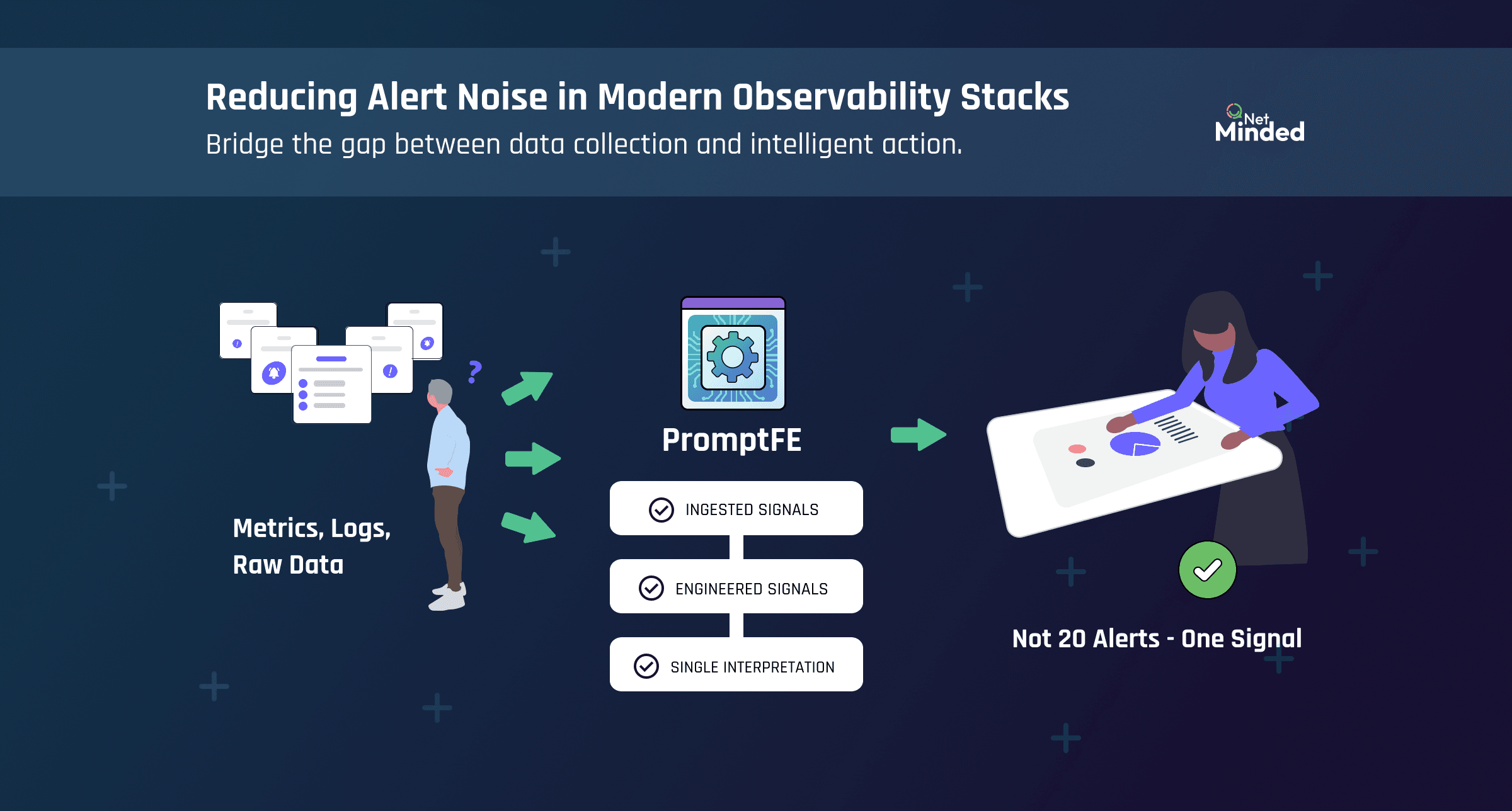
Bridge the gap between data collection and intelligent action.
Modern observability stacks are powerful.
With tools like Prometheus and OpenTelemetry, teams can collect:
Metrics
Logs
Traces
Events
At scale.
In real time.
So why does it still feel like this?
Too many alerts.
Not enough clarity.
The Problem: More Signals, Less Meaning
Most teams don’t suffer from a lack of data.
They suffer from:
Alert storms
Duplicate signals
Conflicting indicators
No clear root cause
A single issue can trigger:
Infrastructure alerts
Application alerts
Network alerts
All at once.
Each technically correct.
But collectively:
Unhelpful.
Why Alert Noise Happens
Observability tools report what they see.
They do not interpret it.
A typical setup might include:
Threshold-based alerts (CPU > 80%)
Rate-based alerts (error spikes)
Event-driven alerts (state changes)
Each one fires independently.
There is no shared understanding of:
What matters
What is related
What action is required
So the system produces noise.
Why AIOps Alone Doesn’t Fix It
AIOps platforms promise to reduce noise.
And they can help.
But they rely on the same inputs.
If those inputs are:
Fragmented
Ambiguous
Lacking context
Then AIOps has to guess.
And guesswork leads to:
False correlations
Missed issues
Low trust from teams
The Missing Layer: From Alerts to Meaning
What’s missing is not another tool.
It’s a signal layer.
A layer that:
Combines related telemetry
Applies domain knowledge
Produces a single, clear interpretation
Instead of dozens of alerts, you get:
Service State: Amber
Context: Error rate increase linked to upstream latency
Confidence: High
Now there is one signal.
Not twenty.
How PromptFE Works With Your Stack
Prompt Feature Engineering sits between telemetry and alerting.
Prometheus / OpenTelemetry → PromptFE → AIOps / Alerts / Automation
It does not replace your stack.
It enhances it.
1. Ingest existing signals
Metrics, logs, and traces flow in from:
Prometheus
OpenTelemetry
Other sources
No changes to collection.
2. Subject matter experts define meaning
Using a sandbox GUI, engineers define:
What normal looks like
What combinations indicate issues
What should trigger action
No code.
Just expertise.
3. Signals are combined and scored
PromptFE applies:
Correlation across signals
Trend analysis
Domain-specific logic
This creates a scoring profile.
A reusable model of judgement.
4. Outputs replace raw alerts
Instead of many alerts, you get:
A single state (Green / Amber / Red)
Clear context
Confidence levels
These outputs feed:
Alerting systems
AIOps platforms
Automation workflows
Why This Reduces Alert Noise
Because noise is not a volume problem.
It’s a meaning problem.
PromptFE reduces noise by:
Merging related signals
Removing duplicate alerts
Adding context upfront
So instead of reacting to alerts, teams act on:
Clear, engineered signals
Why This Improves AIOps
AIOps works best with structured input.
PromptFE provides:
Deterministic signals
Consistent interpretation
Explainable outputs
So AIOps no longer needs to infer meaning.
It receives it.
The Role of the Subject Matter Expert
This is critical.
PromptFE does not replace engineers.
It captures what they already do.
Today, experts:
Interpret dashboards
Correlate signals
Decide what matters
With PromptFE, they:
Define that logic once
Apply it consistently
Improve it over time
AI and automation run on their expertise.
Not instead of it.
The Bigger Shift
This is the transition:
From alerts → to signals
From signals → to meaning
From meaning → to action
The Bottom Line
Modern observability stacks are not broken.
They are incomplete.
They collect everything.
But they do not explain anything.
PromptFE adds the missing layer:
A consistent, explainable signal that both humans and AIOps can trust.
So instead of drowning in alerts, teams can focus on action.

Resources
Copyright NetMinded, a trading name of SeeThru Networks ©