Optical Networking
Network Disaggregation
Coherent Optics
Network Observability
Rebuilding the System View in Disaggregated Optical Networks


Nick Randall
April 1 • 4 Min Read
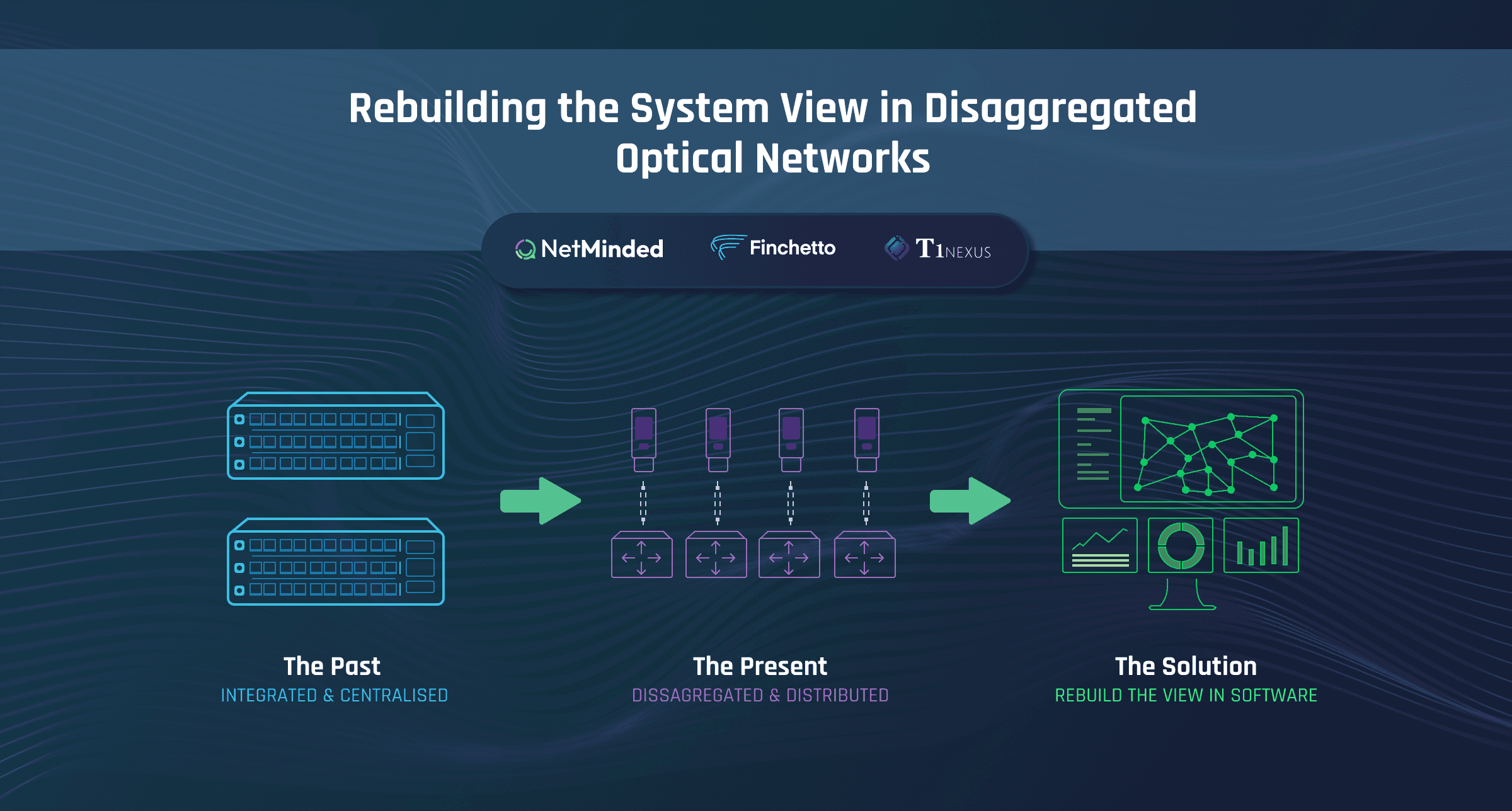
Bringing Clarity to Disaggregated and Coherent Systems
As network architectures evolve, technologies such as coherent optics, disaggregated network switches, and software-defined networking are transforming how infrastructure is designed and deployed. While these innovations deliver clear gains in efficiency, scalability and performance, they also introduce new operational challenges for network engineers.
Over the past eighteen months, our work with Finchetto and, more recently, with T1Nexus has highlighted a recurring pattern. As networks become more distributed and disaggregated, the need to reconstruct a coherent operational view becomes critical for both optical and IP teams.
Disaggregating the Network Switch: The Finchetto Approach
For the past eighteen months or so, we have been working with Finchetto. They do something genuinely novel: they take power-hungry electronic network switches and disaggregate them using photonics.
With Finchetto’s solution, the switch becomes a collection of optical endpoints connected via a high-performance optical backplane. Power consumption and latency are greatly reduced, and switching capacity is increased for massively distributed computing environments.
Technically elegant. Operationally, potentially a shock.
Network engineers were used to managing traditional switches. Now they had something else entirely.
We worked on Finchetto’s behalf to build a control plane that turned that disaggregated system back into something familiar. A virtual switch that a network engineer could understand and operate effectively.
From Optical Transport Systems to Distributed Telemetry
It occurred to me that we are seeing a similar issue with optical networks as we collaborate with our friends at T1Nexus.
Coherent optics such as ZR and DCO are brilliant. They remove layers, collapse infrastructure and simplify architectures.
But they also quietly remove something important: the optical transport layer as an operational system. Instead of a DWDM platform providing a unified, coherent view of the network, telemetry is now fragmented across pluggable optics in routers.
The underlying physics have not changed. What has changed is the ability to see and operate the system as a whole.
The Operational Challenge of Network Disaggregation
Reconstructing an optical “picture” from distributed telemetry introduces a very human problem.
IP network teams and optical transport teams still exist. However, the system that optical engineers once controlled is now disaggregated.
The responsibility has not disappeared.
A Recurring Pattern in Network Innovation
Is this a pattern: innovate by collapsing layers, then spend the next few years rebuilding them virtually so engineers can operate the system?
What we are working on now is essentially the same answer as with Finchetto. We take a disaggregated, distributed system and reconstruct a coherent operational model.
Not by putting the hardware back, but by rebuilding the system view in software.
What This Means for Network Observability and Operations
As coherent pluggables and disaggregated architectures become more widespread, this challenge is likely to grow. Network observability, telemetry aggregation and software-defined control planes will play an increasingly important role in making these systems operable at scale.
Infrastructure will continue to evolve towards greater efficiency and distribution, but operational clarity must be rebuilt alongside it.
We are curious to hear if others are seeing the same patterns as coherent pluggables become more common.
Finchetto
Finchetto was founded in 2020 by Mark Rushworth – a 2x DeepTech founder and expert in integrated photonic design & characterisation – and Michael Pearcey, the inventor of Finchetto’s core IP and a specialist in non-traditional computer systems architecture.
Their team is highly experienced, with expertise founding successful DeepTech companies, inventing core IP, leading major technology firms through multiple exits, and decades of experience in optical and semiconductor manufacturing.
T1Nexus
Founded in 2018 and headquartered in Silicon Valley, we are a US joint venture partnered with leading optical transceiver manufacturers with factories in Asia. Their executive team has played pivotal roles in some of the world’s largest telecommunications companies, bringing a wealth of experience and expertise to our operations.

Resources
Copyright NetMinded, a trading name of SeeThru Networks ©