PromptFE
Prompt Engineering
Feature Engineering
LLM Ops
PromptFE: MNOC and Prompt Feature Engineering


Nick Randall
January 22 • 4 Min Read
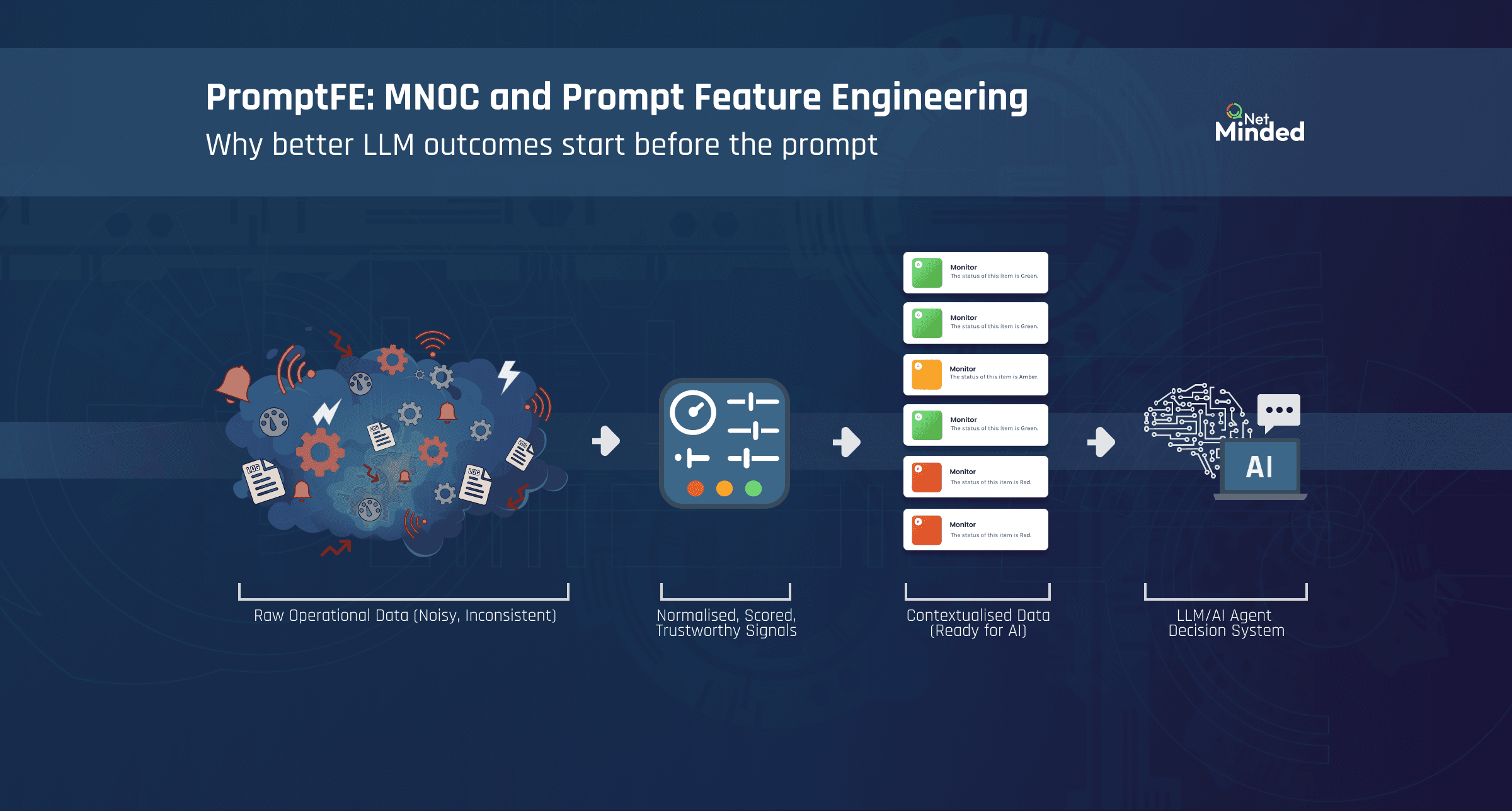
Why better LLM outcomes start before the prompt
For the past year, most advice on improving Large Language Model (LLM) outcomes has focused on prompt engineering - refining wording, adding examples, and iterating on structure.
That works, to a point.
But when LLMs are applied to operational data - telemetry, logs, network tests, events - prompt wording is rarely the real problem.
The problem is the data.
The hidden failure mode of LLMs in operations
Operational systems generate enormous volumes of data:
Metrics sampled at different rates
Logs with inconsistent structure
Telemetry with technology-specific semantics
Events that are noisy, bursty, and ambiguous
When this raw data is placed directly into a prompt, the LLM is forced to:
Infer scale and thresholds
Guess what “good” or “bad” looks like
Reconcile contradictory signals
Reason over noise instead of signal
The result is brittle, non-repeatable answers - regardless of how well the prompt is written.
From prompt engineering to Prompt Feature Engineering
This is where Prompt Feature Engineering (PromptFE) comes in.
PromptFE shifts the focus from how we ask the question to what we present to the model.
Instead of feeding raw telemetry into an LLM, PromptFE emphasises:
Normalised inputs
Scored and ranked signals
Technology-aware thresholds
Explicit confidence and severity indicators
In other words: applying the same discipline used in feature engineering for machine learning to the inputs of an LLM.
Prompt wording still matters - but only after the data has been made intelligible.
MNOC: PromptFE for operational data
MNOC was built to solve a long-standing problem in service assurance:
how to turn diverse, noisy measurements into a shared, trustworthy view of system state.
That makes it a natural fit for PromptFE.
MNOC introduces a scoring layer between measurement and interpretation:
Measure
Collect raw metrics, events, and test results from operational systems.Score
Convert those measurements into normalised, technology-aware scores
(e.g. red / amber / green, low / medium / high, confidence-weighted values).Present
Expose the scored outputs as structured data suitable for:LLM prompts
Agent tools
Automated decision systems
By the time an LLM sees the data, the hard work has already been done.
Why scoring matters
Scoring provides three things LLMs struggle to infer on their own:
1. Semantic stability
A “0.2” means nothing without context.
A “high risk with low confidence” is immediately interpretable.
2. Repeatability
The same inputs produce the same interpretation, regardless of phrasing.
3. Trust boundaries
Humans, automation, and AI agents can all reason over the same scored signals.
This is particularly important in regulated or safety-critical environments, where evidence and explainability matter more than creativity.
PromptFE enables agentic workflows
As teams move toward agentic AI, PromptFE becomes even more important.
Agents need:
Stable inputs
Clear thresholds for action
Confidence measures
Machine-readable structure
MNOC-scored data can be exposed as tools, shared between systems, or federated across organisations - enabling shared awareness without sharing raw data.
Prompt engineering isn’t going away — it’s moving up the stack
Prompt engineering still has value.
But its role changes.
Instead of compensating for messy data, prompts can focus on:
Policy
Decision logic
Escalation rules
Human-readable explanation
PromptFE - and tools like MNOC - handle the messy reality underneath.
Conclusion: better inputs, better outcomes
If LLMs are the reasoning layer, then Prompt Feature Engineering is the interface.
MNOC provides an open, opinionated implementation of PromptFE for operational data — grounded in decades of service assurance practice, not trial-and-error prompting.
Better prompts help.
Better features make a big difference.

Resources
Copyright NetMinded, a trading name of SeeThru Networks ©