AIOps
FTTH
Network Automation
Data Engineering
PromptFE doesn’t replace your AIOps platform - it makes it work


Nick Randall
April 8 • 4 Min Read
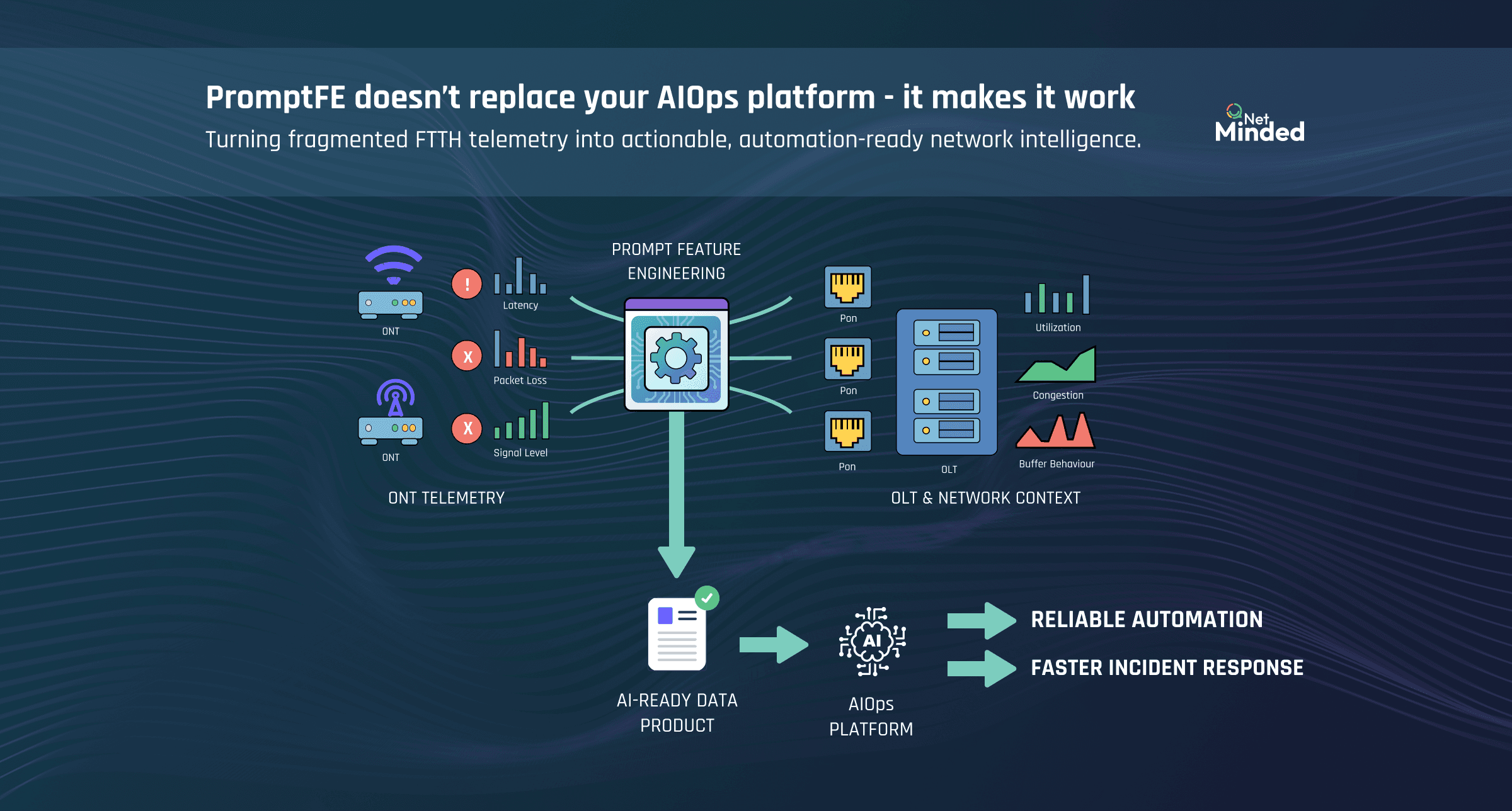
Turning fragmented FTTH telemetry into actionable, automation-ready network intelligence.
Consider the Fibre-to-the-home (FTTH) network operator. FTTH networks are full of data.
Every ONT reports:
Latency
Packet loss
Signal levels
Error counts
At scale, this becomes thousands of data points.
Every few minutes.
So the assumption is:
We must have full visibility.
But in practice, something is missing.
The Problem: AIOps Has Data, But Not Usable Input
Most AIOps strategies assume this:
Collect telemetry → feed it into a platform → get automation.
You already have:
Telemetry pipelines
Platforms like InfluxDB and Prometheus
Dashboards and alerts
But still:
Automation is unreliable
Alerts lack context
Teams fall back to manual triage
This is not a platform problem.
It’s an input problem.
Why ONT-Level Telemetry Isn’t Enough
Most FTTH telemetry lives at the edge.
Per ONT.
Per service.
Per customer.
That’s useful.
But AIOps doesn’t act on individual ONTs.
It needs to understand the network.
At:
OLTs
PON ports
Uplink interfaces
And this is where things break down.
What AIOps Actually Needs
When an issue occurs, the real question is:
“Is this isolated—or systemic?”
To answer that, AIOps needs:
Correlation across many ONTs
Awareness of shared infrastructure
Alignment with OLT-side telemetry
Without that, it sees noise.
The Missing Layer: Correlated Network Context
To make AIOps effective, you need to combine:
From the ONTs:
Latency, loss, jitter
Signal levels
Events like dying gasp
From the OLT:
PON port utilisation and errors
Queueing and buffer behaviour
Uplink congestion indicators
Individually, these signals are weak.
Together, they form a clear picture.
What AIOps Needs to See
Instead of fragmented inputs:
ONT-123: Latency 25ms
ONT-456: Latency 27ms
ONT-789: Dying gasp
AIOps needs structured outputs:
OLT-7 / PON-3: Service State = Red
Context:
– Latency increase across 180 ONTs
– Rising utilisation on PON port
– Burst of dying gasp events
Likely Cause: Access segment instability or congestion
Now automation has something to act on.
Clear state.
Clear scope.
Clear cause.
How PromptFE Makes This Possible
Prompt Feature Engineering provides this missing layer.
It allows subject matter experts to define:
How ONTs map to PONs and OLTs
How edge and network signals relate
What combinations indicate real issues
Using a sandbox GUI, engineers can:
Aggregate ONT behaviour by shared infrastructure
Combine it with OLT telemetry
Define scoring and correlation logic
No code.
Just domain expertise—captured once and applied at scale.
From Telemetry to Automation-Ready Data
PromptFE does not create more data.
It creates better inputs for AIOps.
Each output is a data product with:
A clear state (Green / Amber / Red)
Context (what is happening and why)
Confidence (how strong the signal is)
Provenance (how it was derived)
This removes ambiguity.
Which is what automation needs most.
Why This Changes AIOps Outcomes
Without this layer:
AIOps sees fragmented signals
Automation hesitates or misfires
Teams step back in
With PromptFE:
Signals are correlated
Fault domains are explicit
Automation becomes reliable
You are no longer asking AIOps to interpret telemetry.
You’re giving it decisions it can trust.
The Bottom Line
Most operators already have the tools.
They already have the data.
What they don’t have is:
data that AIOps can actually use
PromptFE doesn’t replace your AIOps platform.
It makes it work.

Resources
Copyright NetMinded, a trading name of SeeThru Networks ©