AI Ops
Data Engineering
AI Readiness
Observability
From Telemetry to AI-Ready Data Products


Nick Randall
April 7 • 6 Min Read
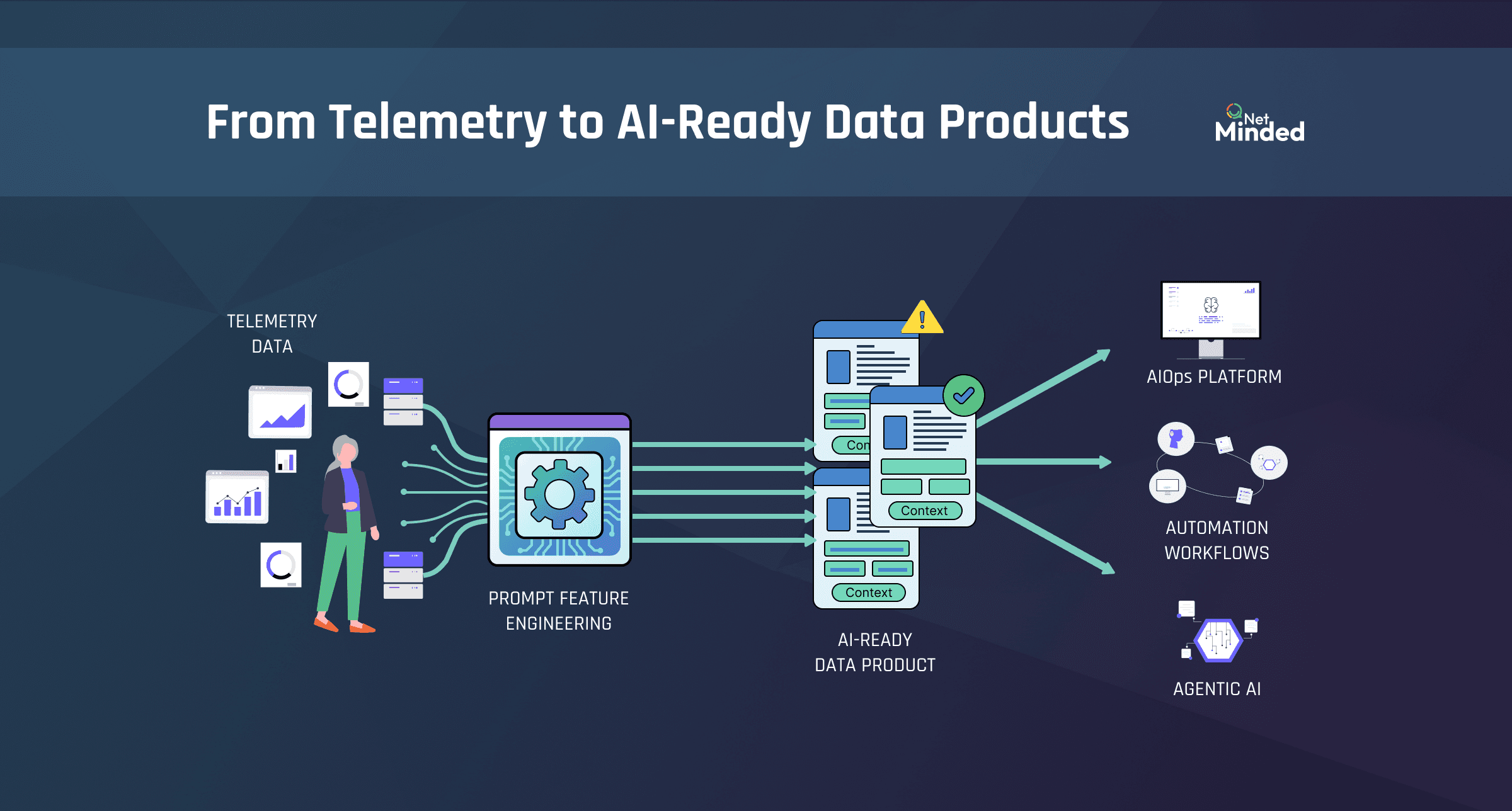
Bridging the gap between raw telemetry and real decisions.
In the last post, we showed how Prompt Feature Engineering (PromptFE) turns raw telemetry into decision-ready signals.
But that raises the next question:
What are we actually creating?
The answer is simple:
AI-ready data products.
The Missing Layer in AIOps
Most AIOps strategies assume this:
Collect enough data → feed it into a platform → get insight.
In reality, something breaks in the middle.
You have:
Telemetry pipelines
Platforms like InfluxDB and Prometheus
Dashboards and alerts
But still:
Teams interpret data manually
AI outputs lack clarity
Automation is unreliable
This is not a tooling problem.
It’s a data quality problem.
Why Raw Telemetry Doesn’t Scale
Telemetry is detailed, but not meaningful.
A system might show:
Latency = 23ms
Packet loss = 0.2%
Jitter = 4ms
But the real question is:
“Do I need to act?”
That answer is not in the data.
It comes from experience.
And today, that experience sits:
In engineers’ heads
In runbooks
In scattered tools
This is why AIOps struggles.
The data has no built-in meaning.
Step Change: From Metrics to Data Products
PromptFE solves this by changing the output.
Not more dashboards.
Not more alerts.
Better data.
Instead of raw metrics, you create a data product:
Service State: Amber
Confidence: High
Context: Latency trending above baseline across shared path
This is:
Structured
Consistent
Explainable
Actionable
How PromptFE Works (In Practice)
There’s nothing mysterious about it, it’s a system of work.
1. Ingest telemetry from existing systems
Data flows in from platforms like InfluxDB, Prometheus, network devices, and APIs.
No rip-and-replace. Just integration.
2. Subject matter experts define meaning
Using a sandbox GUI, engineers describe:
What normal looks like
What patterns matter
What indicates degradation or failure
No coding required.
This is where expertise is captured.
3. Feature scoring profiles add context
Each feature is shaped using:
Thresholds
Trends
Correlations
Domain logic
This becomes a scoring profile—a reusable model of judgement.
4. Outputs are assembled into data products
Each output combines:
The feature (score/state)
Context (why it matters)
Provenance (how it was derived)
The result is a consistent, explainable unit of meaning.
5. Data products feed AI and automation
These outputs are then consumed by:
AIOps platforms
Automation workflows
Agentic AI systems
The AI does not guess.
It receives structured truth.
The Critical Point: This Enables Engineers
There’s a fear with AI:
“Does this replace me?”
PromptFE does the opposite.
It takes what engineers already do—interpretation, judgement, pattern recognition—
and turns it into a system.
The SME is no longer:
Manually interpreting dashboards
Repeating the same analysis
Acting as a human API
Instead, they:
Define the logic once
Scale it across the network
Improve it over time
AI doesn’t replace the expert.
It runs on their expertise.
Why This Improves AIOps Data Quality
Without PromptFE:
Inputs are ambiguous
AI must infer meaning
Results are inconsistent
With PromptFE:
Inputs are deterministic
Meaning is embedded
Outputs are reliable
You are no longer asking AI to interpret telemetry.
You are giving it engineered truth.
Where This Fits in the Stack
The architecture becomes:
Telemetry → PromptFE → Data Products → AIOps / AI / Humans
PromptFE sits between data and consumption.
It enhances tools like Grafana and ServiceNow.
The Bigger Shift
This is the real transition:
From telemetry → to insight
From insight → to action
From action → to automation
The Bottom Line
If you want better AIOps outcomes:
Don’t start with more data.
Don’t start with new tools.
Start with data quality.
Turn telemetry into structured, explainable, AI-ready data products.
And make your experts part of the system—not the bottleneck.

Resources
Copyright NetMinded, a trading name of SeeThru Networks ©