#NetworkAutomation
#AIOps
#DataEngineering
#OperationalEngineering
AI is changing network operations. But what should AI actually consume?


Nick Randall
July 8 • 3 Min read
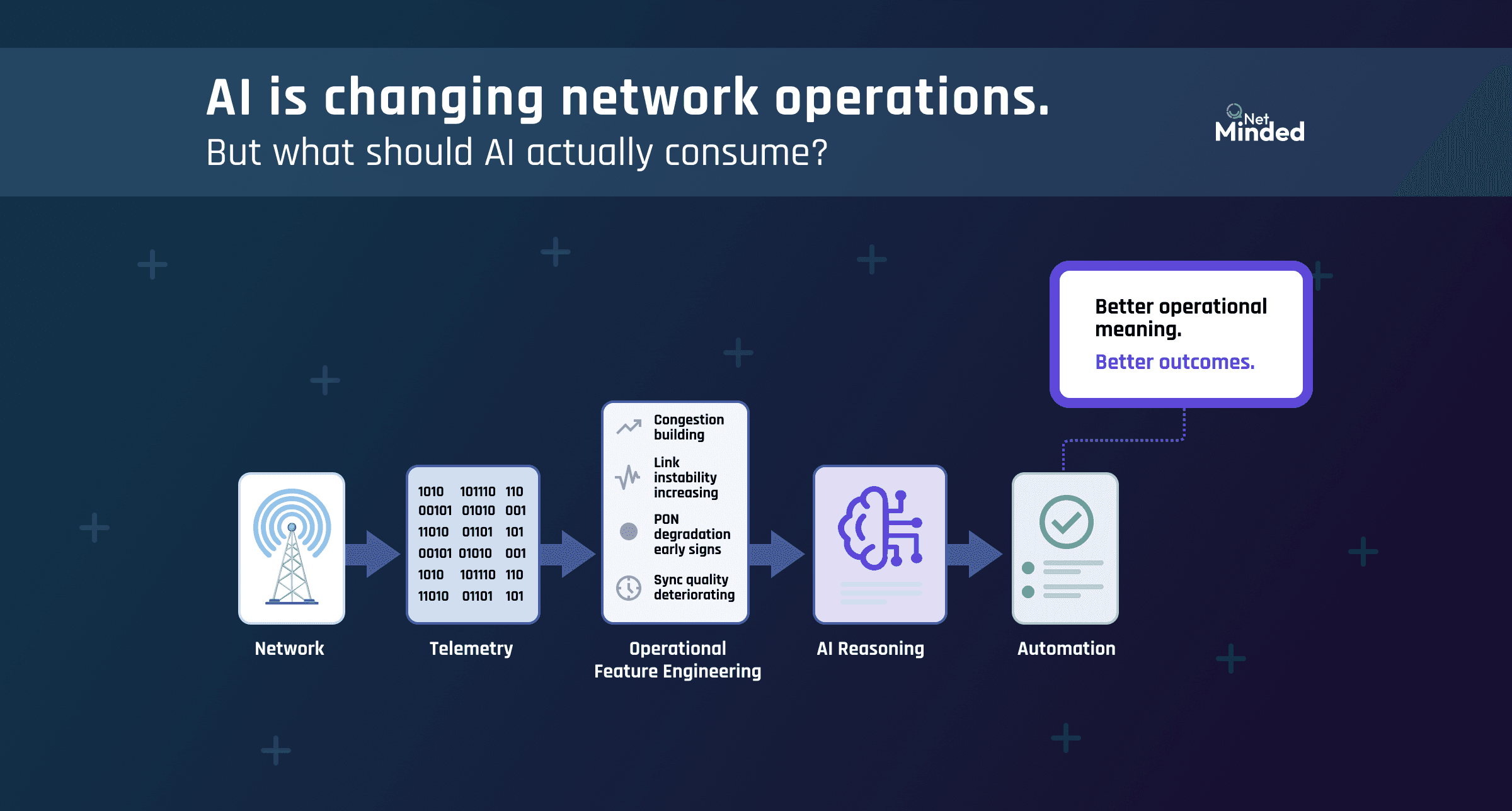
Not raw telemetry, but engineered meaning.
TL;DR
Ericsson's latest paper paints a compelling vision of AI-driven autonomous networks. It got me wondering whether the next competitive advantage isn't building smarter AI, but giving AI better operational information to reason over. We've spent years collecting more telemetry. Perhaps it's time to spend just as much effort engineering its meaning.
Ericsson recently published an excellent paper on AI-driven automation for mobile transport networks. Link below. Their vision is compelling: networks that continuously observe, analyse and act, moving towards autonomous operations.
As I was reading it, one thought kept coming back to me.
We've spent the last twenty years getting incredibly good at collecting telemetry.
Every new platform, protocol and device seems capable of producing even more data than the last.
That has been exactly the right direction.
But I'm beginning to wonder whether we're approaching a point of diminishing returns.
We're now entering an era where the limiting factor may no longer be how much telemetry we can collect, but how useful that telemetry is to AI.
The industry has understandably focused on building increasingly capable AI systems to reason over operational data.
Perhaps the next question is a different one.
Should AI be reasoning over raw telemetry at all?
Raw telemetry is fantastic.
It's invaluable for storage, compliance, auditing and forensic investigation.
But it isn't the language that experienced network engineers use when they think about how a network is behaving.
They don't think in SNMP counters, optical power levels or latency samples.
They think in concepts.
Congestion is beginning to build.
This microwave link is becoming unstable.
That PON is showing early signs of degradation.
Synchronisation quality is deteriorating.
Those aren't raw measurements.
They're engineered interpretations of telemetry, built from years (sometimes decades) of operational experience.
And that's the thought that stuck with me.
What if we captured that expertise before asking AI to reason over the data?
Instead of expecting AI to infer operational meaning from millions of raw telemetry points, perhaps we should present it with deterministic operational features that already encapsulate decades of subject matter expertise.
That doesn't mean less AI.
It means giving AI a much better starting point.
As autonomous networking evolves, I wonder whether the architecture will increasingly look something like this:
Network
↓
Telemetry
↓
Operational Feature Engineering
↓
AI reasoning
↓
Automation
Ericsson's paper does an excellent job describing the final three stages.
The first one is the piece I find myself thinking about most.
Perhaps the next competitive advantage won't simply be better AI.
Perhaps it will be better operational meaning.
I'm hearing that some organisations are already moving in this direction.
If you're building AI for network operations, where do you draw the line between telemetry collection, feature engineering and AI reasoning?
Link to Ericsson’s excellent paper here: https://www.ericsson.com/en/portfolio/networks/ericsson-radio-system/mobile-transport/ericsson-transport-automation-controller

Resources
Copyright NetMinded, a trading name of SeeThru Networks ©